
Crooked trees

I think that I shall never see / A poem lovely as a tree —Joyce Kilmer
We have romantic notions about trees. They are stately, proud, beautiful, majestic, enduring, a meeting place for lovers, playthings for children, ancient and quiet observers of history—and in Tolkien’s mythology, there were once trees who were sentient just as we are.
Yet, not all trees are beautiful. Not all trees are photogenic. Over the years, our Tucson storms have broken off dozens of branches from the Palo Verde tree behind our house, leaving it with limbs that meander here and there in a chaotic series of twists and turns.
But birds still nest there. Even a gnarly, misshapen tree can be a comfort to someone who needs a bit of shade.
I wandered the Outer Banks of North Carolina when I was young. I still remember the trees on those islands, stunted and bent by the relentless salt-laden winds blowing in from the ocean. Yet, on those same islands generations of wild horses have sheltered and raised their young beneath those battered trees.
Trees in the Bible often serve as metaphors for a life well-lived, or at least a life that could be better than it is, a life blessed by God. Take Psalm 1, for example:
Oh, the joys of those who do not follow the advice of the wicked, or stand around with sinners, or join in with mockers. But they delight in the law of the LORD, meditating on it day and night.
They are like trees planted along the riverbank, bearing fruit each season. Their leaves never wither, and they prosper in all they do. —Psalm 1:1-3 (NLT)
I’ve seen trees like that along the rivers where I’ve canoed. Lush, beautiful, and ancient trees overhanging the shoreline, their heavy branches creating shaded pools where fish like to hide, trees that have thrived for scores of years on the fertile alluvial soils beside refreshing waters.
We’re invited to be like those trees. Psalm 1 is a promise that faithfulness to God will yield a life of bounty and flourishing. We’re told to sink our roots deep into the life-giving Word where we will thrive.
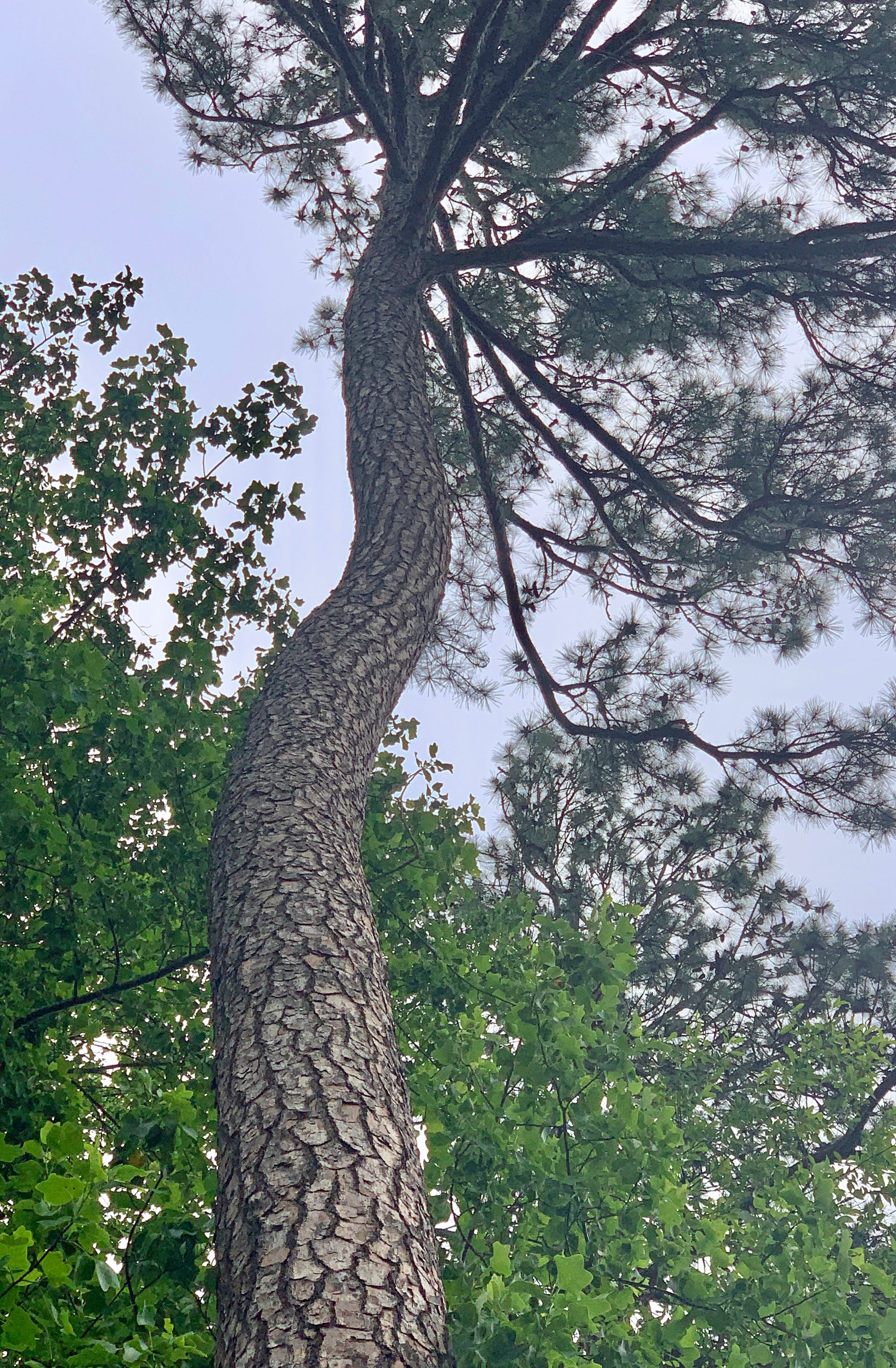
Yet, when I look at myself, when I look back on my life, this is how I picture the tree I’ve become. This is a tree that began well but… something happened, something that caused its trunk to twist and turn, something that made its crown lopsided and misshapen. It carries in its body the after-effects of the storms of life, the insults and difficulties of growing older.
I can tell you that there have been times when I’ve become disenchanted with God, angry with God, times when I turned my back on the God who had come to me with so much mercy and grace and love. I’ve been through storms; life is not one sunshiny day after another.
I have also blown up storms on otherwise peaceful days. Despite knowing better, I’ve often acted selfishly, foolishly, arrogantly, spitefully, not extending the same mercy or grace or love to others that has been lavished on me.
Perhaps right now you’re in the midst of difficulties and disappointments that have broken your limbs and twisted your trunk. Perhaps you’ve even been the cause of pain for others, broken faith with others, been petty and self-serving and uncaring where you could have been kind and generous.
We know that trees planted along a riverbank are sometimes uprooted and swept away by floods. Not all of them, though. There are trees whose roots go so deep into the rocky foundations of the earth that even great floods don’t harm them. They may be bent and battered, but when the waters subside and the land dries out, they live on, they grow, they thrive, they shelter the traveler and provide food and comfort for God’s creatures.
We would not need God’s grace if we were perfect specimens of arboreal magnificence. We are not invited to come into God’s presence because of our competencies; God invites us into his presence because of our need, his skillful healing touch, and his unconditional love.
Yes, I’m a mess at times. Yes, I have many regrets. But I have also been forgiven. I have been planted by my Savior along a fertile riverbank, and have sunk roots deep into the rich soil of God’s renewing Word. Here and there I see buds forming and new growth sprouting from dead branches.
This is God’s promise to all of us. Not that we will be sheltered from storms, but that we will be blessed by this merciful and loving God, and that we in turn will become a blessing to others.
This is the foundational premise of the Gospel of grace. God comes to us not because we are shining examples of human dignity and goodness, but because we are broken people in need of correction and healing and, most of all, forgiveness.
All this we discover in a life lived before the cross of Jesus Christ.
Even a gnarly, misshapen tree can be a comfort to someone who needs a bit of shade.
Amen.