
Gravity

In Alfonso Cuarón’s beautiful film, Gravity, Sandra Bullock is part of a team of US astronauts on a mission to repair the Hubble space telescope. Bullock’s character is Dr. Ryan Stone, a woman weighed down in her earthly life by grief, loneliness, and gravity. She is adrift, going through the motions of life robotically as she tries to forget things that can’t be forgotten.
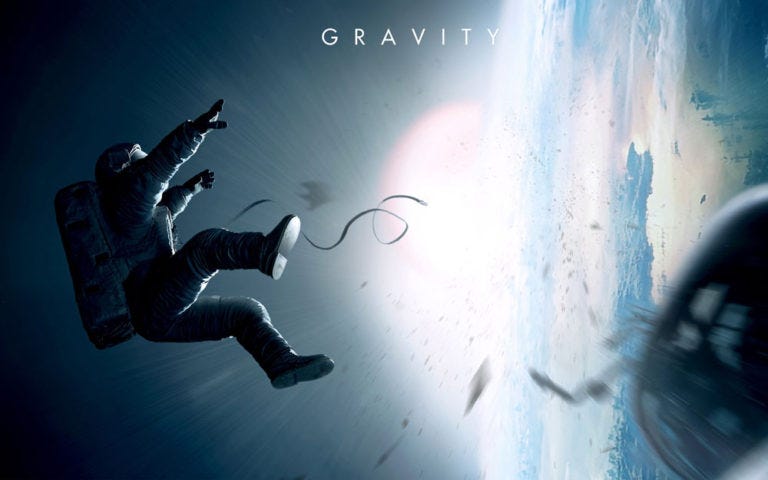
Life on earth is burdensome; outer space leaves you weightless. As you float far above our beautiful blue marble seeing sights few human beings have ever seen, you may find it easy to believe that you’ve left the tragedies of life are far below, far, far away. The reality is quite different: space is cold, inhospitable, deadly. Ryan’s harrowing experiences in space lead her to realize that she’s tired of drifting, that she misses the warmth of the sun, fresh air, and the weight of her body on the soles of her feet. Life on Earth is full of struggle and hardship, true, but Earth is where life thrives, under the relentless pull of gravity.
Since the beginning of the exploration of space, only 553 men and women from 36 nations have experienced weightlessness in space flight; the rest of us have never known what it’s like to be free from gravity. Military and acrobatic pilots can briefly experience negative G’s, roller-coaster enthusiasts may experience the sensation for a few seconds at an amusement park. But even in those circumstances gravity is still pulling us down, always down. We feel its power when we push ourselves up out of bed in the morning, joints creaking and muscles rebelling; we feel the relentless burden in our bones as we lay back down to sleep at night.
At this moment, four astronauts are flying home in a tiny spacecraft that has just circled behind the moon. Their mission is one of leaving and returning, escaping gravity and then falling back through Earth’s atmosphere to be reunited with family, colleagues, homes, and the weight of life on solid ground.
Gravity the film is an allegory which contrasts the heaviness of life’s many burdens with the great beauty and wonder of life, beauty that is able to help us bear up under so much weight.
Think for a moment about the complexities that make up our everyday existence. What if the sorrows and uncertainties and fears that press down on us are the very things that cause us to seek a connection to God? In nature, gravity warps space, causing light itself to seem to bend, to curve. Starlight behaves like a pitcher’s curve ball because of gravity.
Which makes me wonder: If gravity is able to curve a beam of light, perhaps the “light” of our Creator God moves close to us as we suffer, as we grieve, as we hurt, as we are weighed down heavily by so many troubles. Perhaps the human gravitational burdens that threaten to crush us may also give us reason to invite the light of God to come into our circumstances.
I can think of a number of problems with that analogy, and yet, standing up under the force of gravity and withstanding the burden of life’s troubles, disappointments, hardships, etc. have certain similarities.
Jesus spoke often of the “kingdom of heaven” and “the kingdom of God.” He was describing something hard to understand, something that’s simultaneously a place, a state of mind, a way of life, and a force that pulls us steadily towards God. Over and over again he taught that the kingdom of heaven has come near to us, like some dark moon that’s been captured in the Earth’s orbit and is invisibly shifting the tides and warping the seas without our noticing its presence.
As I’ve read about this kingdom of God, I’ve come away with a picture of a reality that’s vastly different from this one, and vastly more attractive. It’s a reality soaked in justice and drenched in beauty, a reality in which kindness and mercy and generosity are commonplace. It’s a kingdom full of so many of the things we say we want for our world, for ourselves. God wants to bend people towards his kingdom, but we resist.
We feel the security of gravity in our toes and the warm sun on our faces, yet we also feel the shock of human depravity, the agony of rampant injustice, and the smell of decay in a world that was once a fragrant garden. We’ve grown used to gravity, we feel at home with the earth solidly beneath our feet, but sometimes we wish, I wish, to free myself from gravity and escape the weight of all this sorrow.
Sunday was Easter, a remembrance of the morning Christ defeated both gravity and death. He was killed by the weight of his body straining to the breaking point against the cross. He was raised by the power of the loving God who placed the planets in their orbits around the Sun. He lived as we live. He rose as God has promised we will rise.
But for now, there is the weight of life on our bones and in our hearts to struggle with. As I sang on an outdoor stage at our Easter sunrise service, I saw and remembered building parts of that stage with my son who is no longer here. We dug holes and shaped steel and poured concrete. We sweated together and laughed together and completed work together that we were both proud of, work that has lasted. Work that outlasted him.
Then Jesus said, “Come to me, all of you who are weary and carry heavy burdens, and I will give you rest. Take my yoke upon you. Let me teach you, because I am humble and gentle at heart, and you will find rest for your souls. For my yoke is easy to bear, and the burden I give you is light.” —Matthew 11:28-30 (NLT)
The weight of gravity pulls us down. The Spirit of the living God promises to lift us up.