
Resurrection questions

I want to know Christ and experience the mighty power that raised him from the dead. I want to suffer with him, sharing in his death, so that one way or another I will experience the resurrection from the dead! —Philippians 3:10-11 (NLT)
[Jesus] suffered under Pontius Pilate; was crucified, dead and buried: He descended into hell: The third day he rose again from the dead: —excerpt from The Apostle’s Creed
I’ve been to a fair number of funerals and watched caskets holding the earthly remains of human beings lowered into the ground. I’ve walked through the American Cemetery in Normandy, France, where each beautiful cross or Star of David marks the final resting place of a soldier who died in battle. In the entire history of the world, death has been final and irreversible.
Until Jesus.
At least, that’s the Easter claim. It’s the New Testament’s claim. It’s the claim of the men and women who were his disciples, his friends and followers, who speak across history about something they witnessed and reported.
Prior to his death, some of those same witnesses claim Jesus himself brought three people back to life after they had died: the very sick young daughter of Jairus, a synagogue leader (Mark 5:22ff); the son of a poor widow in the town of Nain (Luke 7:11ff); and Lazarus, the brother of Mary and Martha (John 11:1ff). The last one became so controversial that, ironically, it stoked a plot to have Jesus and Lazarus murdered.
Jesus is claimed to have had the power to reverse death, and what is more important to the faith, Jesus claimed that he, himself, would rise from the grave bodily, whole, fully alive and well following his death by Roman crucifixion.
On this one audacious claim rests the validity of the Christian faith. Why? Shouldn’t it be possible to accept some of Jesus’ wisdom and moral goodness without buying into all that hocus-pocus about miracles and people becoming undead?
Not really, or at least not easily. He claimed many times throughout his ministry to be able to forgive sins. In other words, he claimed to have some sort of ultimate judicial authority, moral authority, to be able to wipe clean the slate of wrongs committed by other people. It’s an audacious and reckless claim. Perhaps it was just an empty boast?
The religious leaders didn’t think so.
Now some teachers of the law were sitting there, thinking to themselves, “Why does this [Jesus] talk like that? He’s blaspheming! Who can forgive sins but God alone?” —Mark 2:6-7 (NIV)
By claiming he could forgive sins, he was making himself equal to the gods — or the one true God that Israel worshipped. So this claim, too, is problematic, and if we’re dealing with a fellow who thinks he’s equal to God, we’re justified in questioning his other claims, his wisdom, his sanity.
That’s for theologians to sort out. For us, maybe the more relevant question is to wonder if it is simply unscientific and anti-intellectual to believe Jesus rose from the dead?
My answer is no, not at all. Science can only tell us about what is and is not possible in the material and time-constrained universe. If there is a God of the sort described in the Bible, and if that God visited the earth in the guise of Jesus Christ, all scientific and intellectual analysis of what such a being would be capable of goes out the window. There is nothing unscientific about postulating a being who is not constrained by the material laws and realities we live with. There are already those in physics, serious thinkers, who believe there might be multiple parallel universes, each one independent of and unaware of the others. As wild and crazy ideas go, the idea that there might be a God who created all of this materiality and life seems tame by comparison.
The witnesses quoted in the New Testament claimed Jesus actually appeared in bodily form to them on multiple occasions following his death. He spoke. He taught. He ate. They touched him. They were astounded, dumb-founded, as any of us would be, which is why I love the way Caravaggio portrays the famous scene where the disciple Thomas, “doubting Thomas”, touches Jesus’ wounded but resurrected body and declares that he believes.
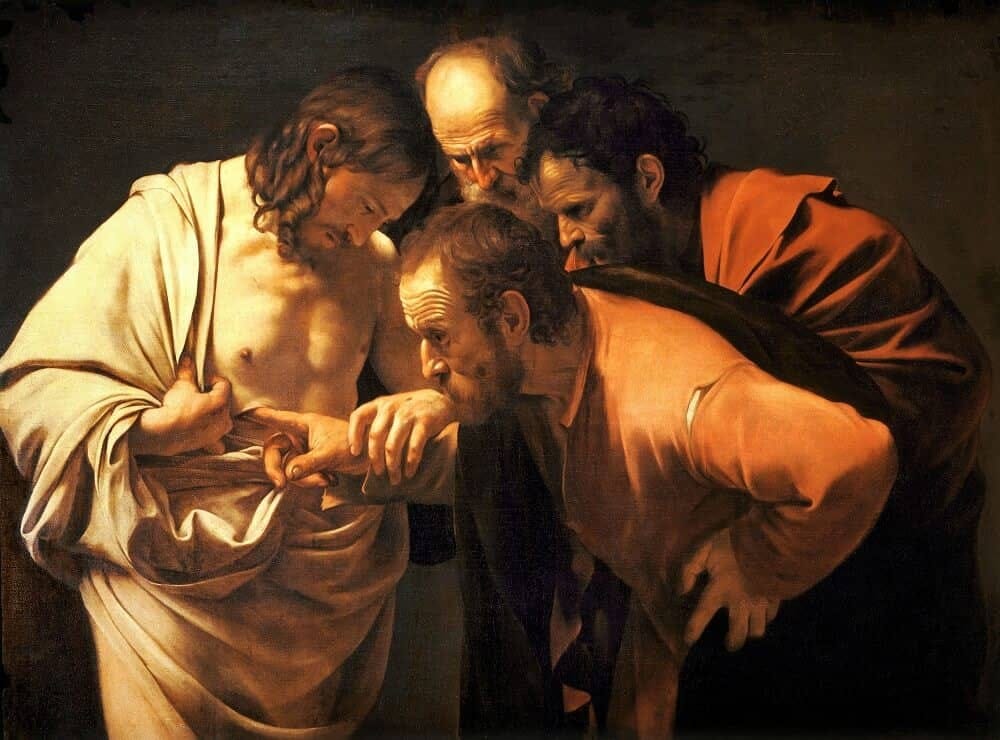
I’m right there with Thomas. The resurrection of the dead is not easy to accept.
Paul writes that we, too, are able to attain the resurrection from the dead, just like Christ. Jesus showed that death is not an immutable law. Taxes, yes, but not death. In overcoming death and offering us forgiveness, and by that forgiveness restoring our relationship with the holy God, Jesus also offers us a way through death, past death, beyond death.
On Easter we look back at the empty tomb and the resurrected Jesus and see it as God’s eternal covenant with humanity. God has given us a way forward, a way towards hope and light and life. We look backwards and remember. We look forward and believe that because Jesus was raised from death, we too, through God’s mercy and grace, are able to attain the very same resurrection from the dead.
Easter challenges us to confront the claims of the disciples and confront this very consequential question for ourselves: did Jesus actually rise from the dead? And if so, what am I going to do about it?
Without His life and resurrection everything is just a passing event that happens and is gone. With His life and resurrection we have so much waiting for us that the past and our lives and death seem like like a rock thrown in a pond and the ripples quickly dissipate, but that is not the end. There is so much waiting for us on the other side!
From early childhood, I attended each of the markedly pensive Wed. evening Lenten services, Maundy Thursday, Good Friday, and of course, all of the Sunday Easter services. Attending all of the Easter services was in part, because I was first in Jr. Choir, and from 7th grade on, in the adult choir. But mainly because I loved being in church where the Lord’s Love abounded and there was a Peace that our big family didn’t seem to often have.
For me, Holy Week with its opportunity to contemplate on the Lord’s suffering that culminated in the joy and celebration of His Victory over death, was and is a time of praise and thanksgiving for the great gift of His Resurrection. It daily sustains me and brings me peace and joy no matter what the circumstances. Alleluia! Christ is Risen!